Heritage Coast Fiji — Vuda Saweni

Australia’s waste problem is not Fiji’s to solve.

A $1.4 billion industrial incinerator is proposed for Saweni Beach — one of the most sacred and beautiful coastlines in the Pacific. We say no.

What They’re Planning

TNG Holdings Fiji — backed by Australian billionaire Ian Malouf and local partner Rob Cromb — has submitted plans to build an 80-megawatt waste-to-energy incinerator on the Vuda-Saweni Heritage Coast, near Lautoka. The facility would sit on an 85-hectare peninsula, clearing more than 25 hectares of pristine mangroves to make way for two towering smoke stacks and a private deep-water port.

900,000 tonnes of waste burned every year
80m high — two smoke stacks
85ha of Heritage Coast taken for industry
$1.4B AUD project cost
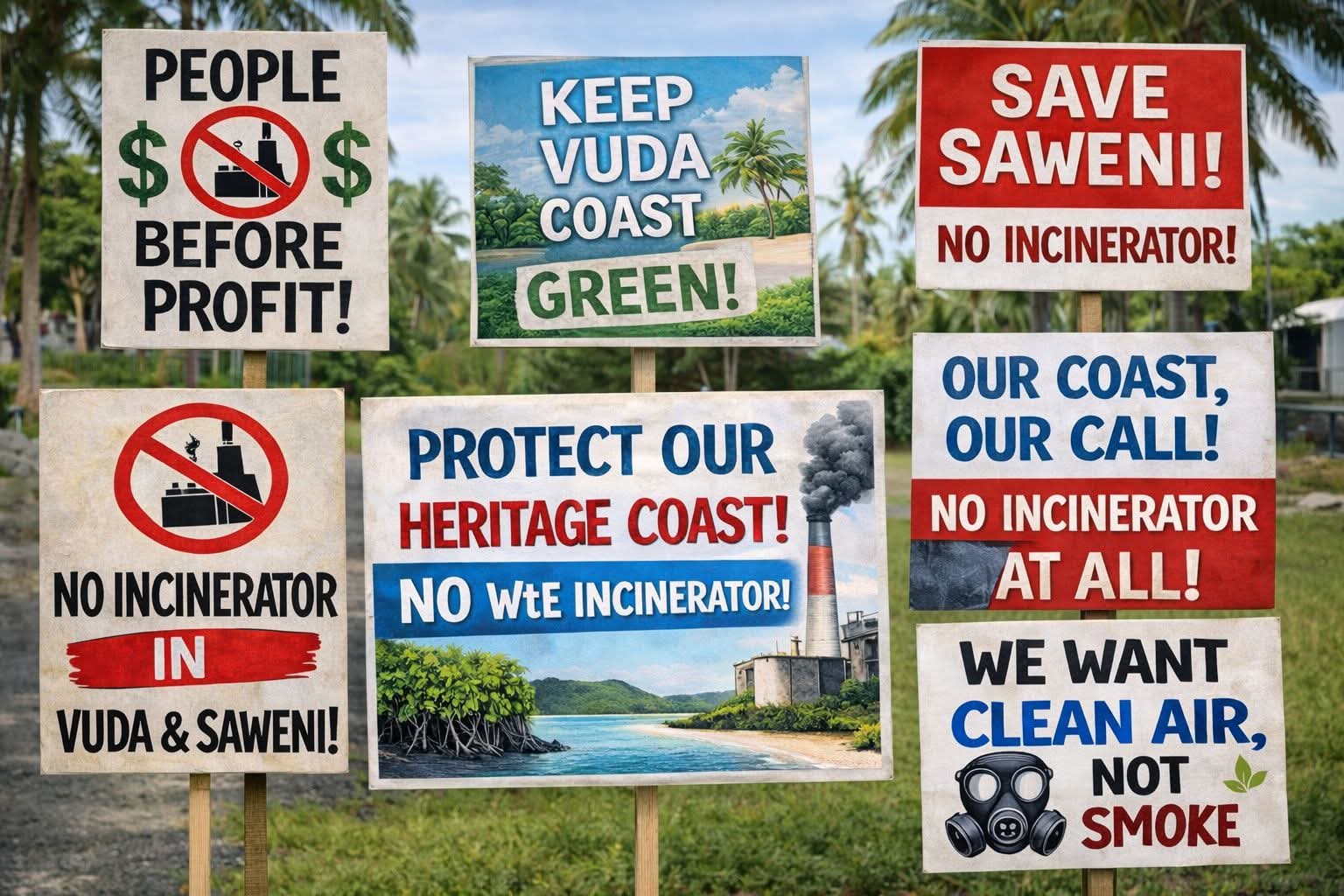
Community protest signs at Vuda and Saweni opposing the incinerator

This Land Is Not A Dumping Ground

The Vuda-Saweni Heritage Coast carries the deepest significance in Fijian history. This is the legendary site of the first landing of the iTaukei people — the ancestral beginning of the Fijian nation. Its name is not marketing. It is memory.

Today it is home to Saweni Beach, Vuda Marina, First Landing Resort, and the mangrove-rich Dreketi Inlet. It draws 450,000 international visitors every year. It is formally zoned for tourism — not industry.

The Tui Vuda — the paramount chief of this land — has signed the petition against this project. The land’s own custodians have spoken.

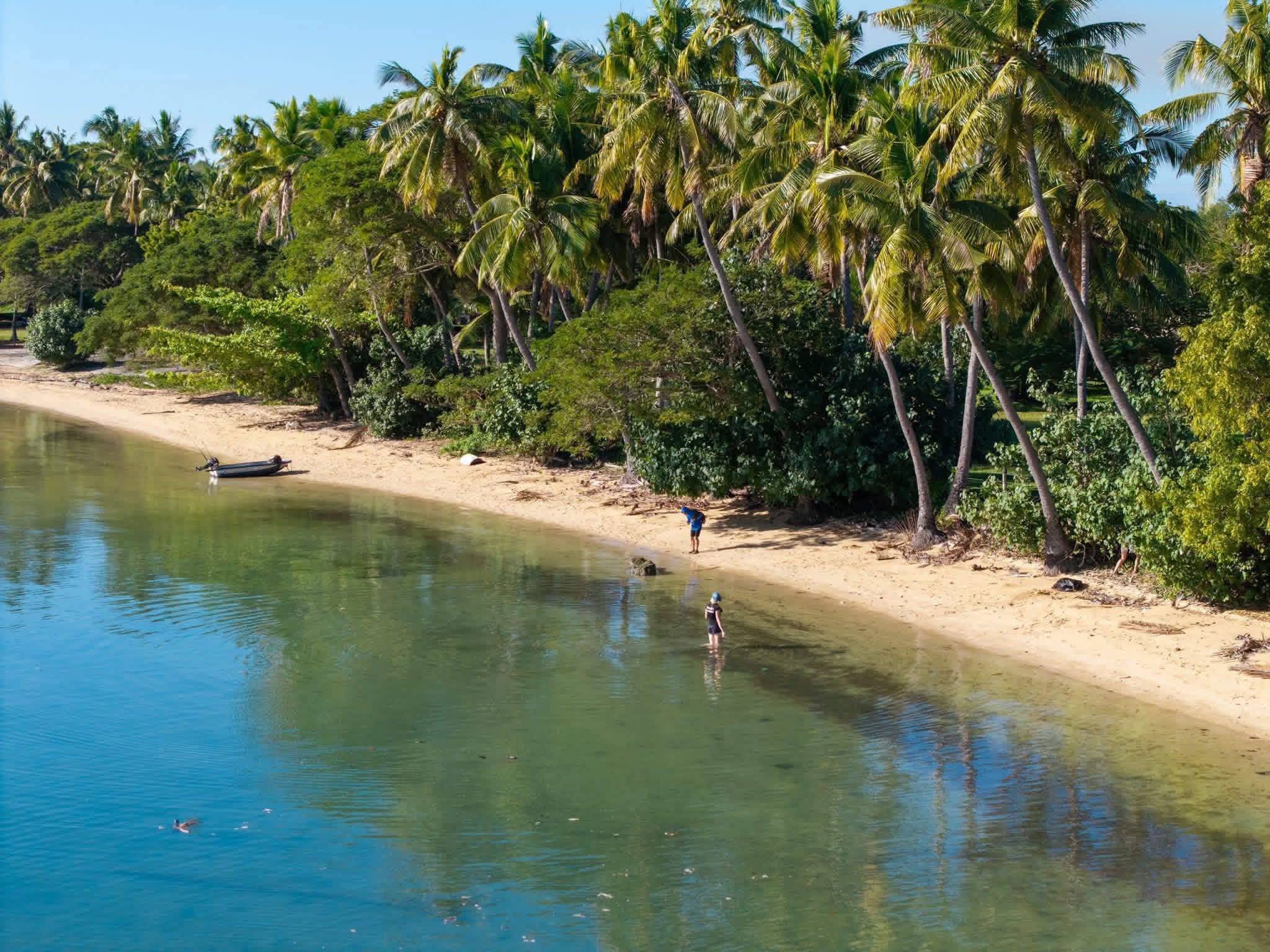
The pristine Heritage Coast at Saweni Beach, Vuda, Fiji

If This Is Such A Good Idea, Why Not Build It In Australia?

The answer is simple: Australia’s own laws won’t allow it. The investors behind this project face a domestic waste crisis — Australian landfills are predicted to reach capacity by 2030. But they cannot solve it at home, so they found somewhere smaller, somewhere further away, somewhere they thought might not push back.

01
Australia’s Hazardous Waste Act

Classifies all household waste — sorted or unsorted — as hazardous. Confirmed in writing by Australia’s own Department of Climate Change, Energy, the Environment and Water.

02
The Waigani Convention (2001)

Signed by both Australia and Fiji. Explicitly prohibits the export of hazardous waste from developed nations to Pacific Island states. This project depends on exactly that.

03
No Licence Even Applied For

The Australian Government has confirmed it has not received any formal waste export licence application from TNG Fiji. The legal pathway was never established — it was assumed Fiji would not look.

“Fiji must not become the Pacific’s ashtray.”

Filipo Tarakinikini — Fiji’s Ambassador to the United Nations

The Damage Is Irreversible

Environmental

  • 25+ hectares of pristine mangroves destroyed at the Dreketi Inlet
  • 200,000 tonnes of toxic bottom ash produced every year — permanently stored in Fiji
  • 30,000 tonnes of toxic fly ash annually, carrying dioxins, heavy metals, and persistent organic pollutants
  • PM2.5 fine particulate emissions across the Western Division
  • Reef contamination from ash runoff and dredging
  • Site sits in a seismically active, cyclone-exposed zone — ash stockpile risk entirely unaddressed in the EIA

Economic

  • Tourism revenue in the Denarau/Western corridor projected to fall 5–25%
  • Coastal agricultural market value projected to fall 10–40%
  • Fiji’s sovereign debt at risk if government provides financing or guarantees
  • 450,000 Australian and international visitors per year — Fiji’s most loyal tourist base — put directly at risk
  • Fiji’s reputation as a clean, green Pacific paradise: priceless and irreplaceable

Cultural

  • The first landing site of the iTaukei people — reduced to an industrial waste facility
  • Generations of ancestral memory, erased for an investor’s balance sheet
  • A living heritage designation, carrying the weight of Fijian origin — gone forever

Burning Rubbish Is Not Clean Energy

Proponents call this a clean energy project. It is not. From the ships hauling waste across the Pacific to the toxic ash left permanently in Fijian soil, waste incineration is one of the dirtiest forms of energy production on earth — and Fiji has far better options.

The Shipping

40,000+ container loads of waste shipped from Australia annually, each vessel burning bunker fuel — one of the most polluting fossil fuels in existence. The carbon cost begins before a single tonne is burned.

The Burning

Incineration releases dioxins, furans, heavy metals, nitrogen oxides, and PM2.5 fine particulates. These are not byproducts of a malfunction. They are the inevitable chemistry of burning mixed waste at scale.

The Ash

230,000 tonnes of toxic residue produced every year — bottom ash and fly ash carrying persistent organic pollutants and heavy metals — stored permanently in Fiji’s land and water. Forever.

The Lock-in

Waste-to-energy plants operate for 25–30 years. They require a constant supply of waste to be economically viable. Countries that built them found they then had a perverse incentive to generate more waste, not less. This is not a path to sustainability. It is the opposite.

Fiji has better options

Solar

Fiji sits in one of the highest solar irradiance zones on earth. Large-scale solar farms already operating in the Pacific generate clean electricity at a fraction of the cost of incineration — with zero toxic emissions and zero ash.

Hydropower

Hydro already provides a significant share of Fiji’s electricity. Expanding existing capacity and developing new run-of-river projects offers clean, reliable baseload power without industrial pollution.

Wind & Tidal

Fiji’s coastal geography gives it exceptional wind and tidal resources that are almost entirely untapped. These are the energy technologies of the future — not burning other countries’ rubbish.

Reduce & Recycle

The most sustainable approach to waste is not to burn it — it is to create less of it. Proper recycling, composting, and waste reduction programmes would address Fiji’s actual waste challenge without creating a new, far larger one.

The 80MW this plant would generate could be produced far more cleanly by solar — at lower cost, with no toxic ash, no dioxins, and no ships burning bunker fuel across the Pacific.

They Keep Changing Their Story

Since submitting their EIA in March 2026, the developers have given three different answers to the most basic question: whose waste is this?

March 2026 — The Original EIA
900,000 tonnes per year. Approximately 700,000 tonnes to be imported from Sydney, Australia. 200,000 tonnes from Fiji and the Pacific. A private deep-water port included in the design.
After Public Outcry — Sudden Revision
Developer Rob Cromb says the 700,000 tonne figure was “misinterpreted” — a “theoretical maximum capacity, not a confirmed operational model.”
Current Claim — “Fiji Waste Only”
The plant is now claimed to be for Fijian domestic waste only. But Fiji produces approximately 200,000 tonnes of waste per year. So why build a 900,000-tonne facility with a private deep-water port capable of receiving bulk carrier ships from Australia?
The business model has never changed. Only the story has. A company that cannot give a consistent answer on the most fundamental question of its own project should not be trusted with the future of Fiji’s Heritage Coast.
Fiji Has Spoken

This is not a fringe concern. The opposition spans traditional leadership, government, civil society, international diplomacy, and sport.

9,000+ petition signatures presented to the Department of Environment
875 written submissions opposing the EIA
7 provincial district councils called for rejection

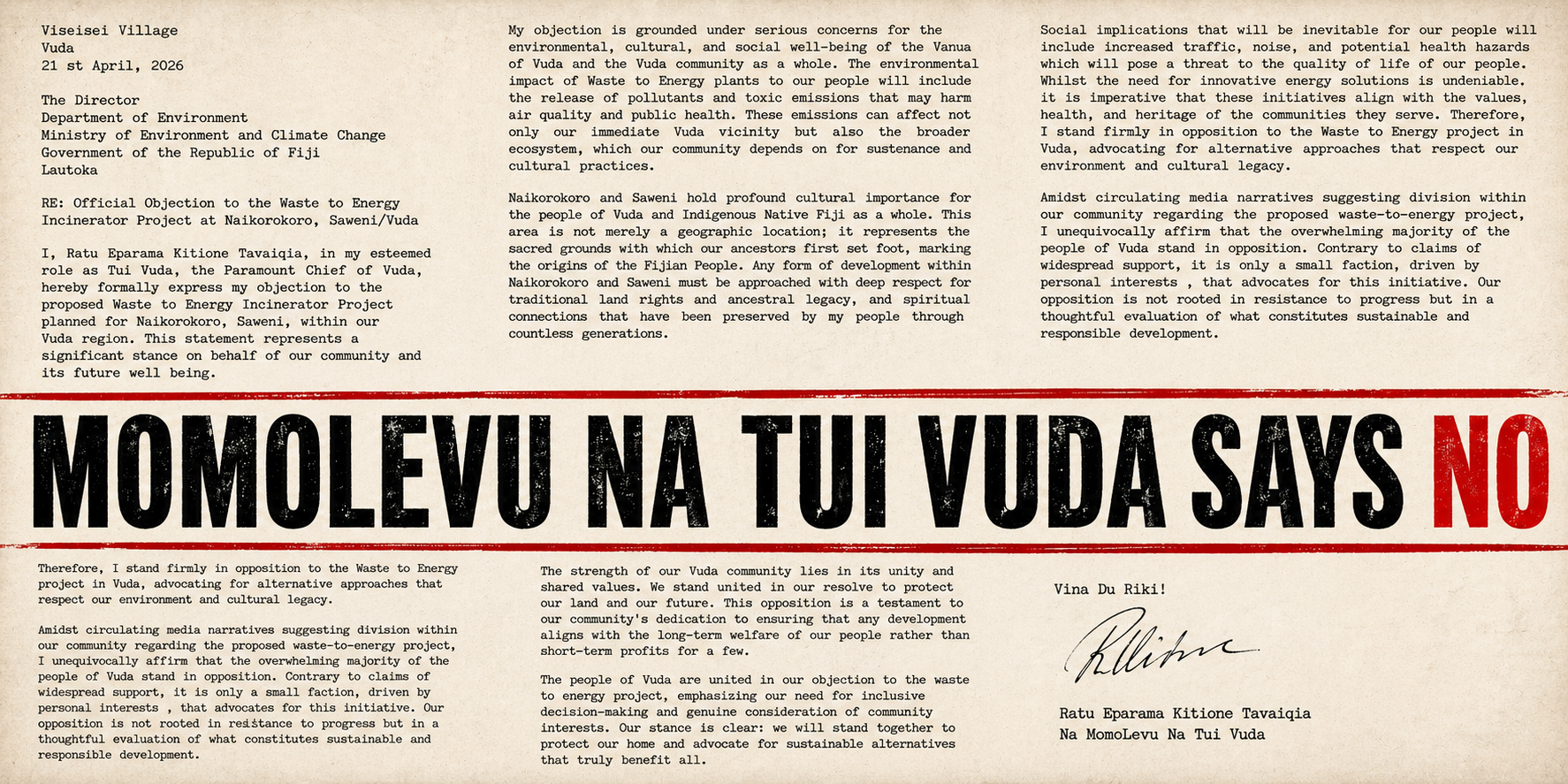
“Naikorokoro and Saweni hold profound cultural importance for the people of Vuda and Indigenous Native Fiji as a whole. This area is not merely a geographic location — it represents the sacred grounds with which our ancestors first set foot, marking the origins of the Fijian People.”

Ratu Eparama Kitione Tavaiqia — Na MomoLevu Na Tui Vuda
Paramount Chief of Vuda. Official letter of objection to the Department of Environment, 21 April 2026.
Official letter of objection from Ratu Eparama Kitione Tavaiqia, Na MomoLevu Na Tui Vuda, Paramount Chief of Vuda — MOMOLEVU NA TUI VUDA SAYS NO
Official objection letter — Ratu Eparama Kitione Tavaiqia, Na MomoLevu Na Tui Vuda

Those who have publicly opposed this project include:

  • Tui Vuda — Paramount Chief of Vuda
  • Vuda Resources Development Committee
  • UN Ambassador Filipo Tarakinikini
  • Fiji Labour Party
  • People First Party
  • Fiji Rugby Union
  • Hotel & Tourism Operators, Western Division
  • Western Division Business Leaders

Get In Touch

Have information about the project? Want to get involved? Send us a message.